Remote Sensing and Modeling of Coral Reef Resilience

A new paradigm has emerged for management of coral reefs in an era of changing climate – managing for resilience. A fundamental need for such management to be effective is our ability to measure and map coral reef resilience. We review the resilience concept and factors that may make a coral reef more or less resilient to climate-driven impacts, and focus on recent advances in a trio of technologies – remote sensing, spatial distribution modeling, and ecosystem simulation – that promise to improve our ability to quantify coral reef resilience across reefs.

Climate Change, Coral Loss, and the Curious Case of the Parrotfish Paradigm: Why Don’t Marine Protected Areas Improve Reef Resilience?

Scientists have advocated for local interventions, such as creating marine protected areas and implementing fishery restrictions, as ways to mitigate local stressors to limit the effects of climate change on reef-building corals. However, in a literature review, we find little empirical support for the notion of managed resilience. We outline some reasons for why marine protected areas and the protection of herbivorous fish (especially parrotfish) have had little effect on coral resilience.

Marine protected areas increase resilience among coral reef communities

With marine biodiversity declining globally at accelerating rates, maximising the effectiveness of conservation has become a key goal for local, national and international regulators. Marine protected areas (MPAs) have been widely advocated for conserving and managing marine biodiversity yet, despite extensive research, their benefits for conserving non-target species and wider ecosystem functions remain unclear.

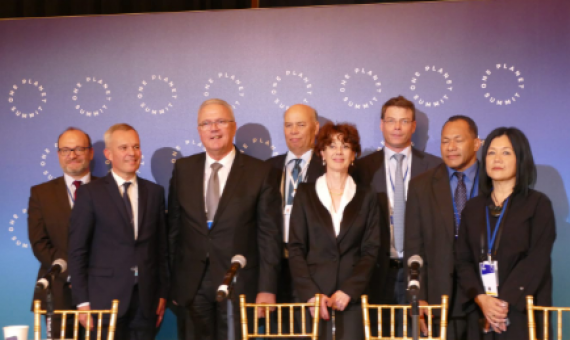
The joint initiative, worth €21 million, was launched during yesterday's One Planet Summit in New York...the EU, France, Australia and New Zealand have joined forces to make it a reality. Click on the link below to read the full article. 

SPREP Invites Applications From Interested And Suitable Qualified Persons For The Following Vacancy: Monitoring and Evaluation Officer, PACRES. Click on the link below for further details.

The theory behind networks of marine reserves is that they allow protected pathways for species to grow and maintain populations through their lifecycle - from where individuals begin their lives (typically as planktonic larvae) to where they disperse and live later as adults.Click on the link be